
The longer Story
After a lifetime working in the book business (mostly educational publishing), Gerard Charles Wilson now concentrates on his writing.
One of his formative experiences was living in Holland with his Dutch wife for two and a half years. On returning to Australia, he completed a major in Dutch Language and Literature before a master’s degree in philosophy. His studies and immersion in another culture and language, together with his Catholic faith, form the biggest influences on his writing. But shaping those influences are his mother and father. One could not have more principled parents.
His master’s thesis was on Edmund Burke, whose thought suffuses his writing. His preoccupations are social and cultural from a Catholic and (Burkean) conservative perspective. This reflects his acceptance of the Catholic idea of the reciprocal relationship between faith and reason.
His favourite fiction authors are Charles Dickens, Jane Austen, and Evelyn Waugh. Evelyn Waugh’s style and mastery of English have been his biggest influence – not in vain, he hopes. His favourite modern non-fiction author is philosopher Roger Scruton. He spends his leisure time reading and occasionally walking along the nearby shores of Port Phillip Bay. He loves opera, musicals, and ballet (The Nutcracker is his favourite). He enjoys fifties rock ‘n’ roll and forties big band. Mozart is his favourite classical composer, but he is acquiring a liking for Bach.
His novels are in the cross-over genres of the ‘Catholic novel’ and the historical novel. They are in the style of Catholic novelists Evelyn Waugh, Graham Greene, and Morris West. He deals with similar political, philosophical, and moral issues, but is much influenced by the way Dickens included social and political themes in his stories. The difference from general fiction is the assumed philosophical framework. Most modern fiction assumes a materialist framework, whereas the Catholic novel assumes a natural-law framework. Finally, there is always a romantic content in his stories. Love relationships are an incisive way of exploring the human person.
Confessing you’re ‘still in the fifties’—which Gerard has done provocatively—to a particular class is like saying you’ve been in jail for the average person, with the difference that the disqualification from the first group would be irredeemable. Luckily, that does not worry Gerard.
To boast that one is still in the fifties is, of course, not to entertain some grandiose idea of transporting our Western Society back through time—to state the obvious. But there is the ethos of the 1950s—an outlook that still exists, even if only as an ideal for some people who (mistakenly) think it lost forever. It is that framework of manners, law, customs, convention, (Christian) religion, morals, politics and the intellectually indefinable that Gerard’s mind is rooted in and is far more than an abstract ideal. As manners and customs can be rejected, they can always be accepted again, regardless of time.
This framework of thinking governs all his writing. All of Gerard’s writing (fiction and non-fiction) is thus about that great rupture in Western Society that occurred during the 1960s and 1970s (1960-1975). The ideas and effects of that cultural revolution connect his books.
Saying he is still in the fifties is also a way of saying he is in that stream of Western Civilisation that has come through from the British Isles to that land mass now called Australia. Australia is a unique form of that stream.
Gerard was born in 1946 to devout Catholic parents and named after the patron saint of pregnant mothers, St Gerard Majella. It never occurred to him to ask his mother if there was any story behind that. A difficult pregnancy? It’s too late now.
Except for two who arrived on the First Fleet in 1788, all his ancestors came to Australia in the early 1800s, none later than his great-great-grandparents. Most were from different parts of England. There were three Irish great-great-grandparents and two Scottish great-grandparents x 3, the Protestant Burgesses, husband and wife with their two children from Aberdeen. They were free settlers, literate people with elevated ideas of how one should behave. They exercised a significant influence on his mother’s family line, and consequently on his family.
Among his original Australian ancestors from the British Isles, he found nine convicts, all of whom made good, one with suitable irony becoming a judge’s tipstaff or law clerk. Convict labour and perseverance, often in harsh circumstances, formed the backbone of Australian colonial society and determined the culture that developed. Knowledge of his ancestral background, particularly of the convict element, has profoundly influenced his self-perception. Information about and his reflections on his pioneering ancestors are found in the first book of his social history series, Prison Hulk to Redemption, A History of a Catholic Family, Part One, 1788-1900.
His childhood in Lane Cove, an inner suburb of Sydney, was idyllic. His father, a World War II veteran and the most principled man he has known, was hardworking, with only the family’s welfare in view. His mother similarly gave her all to the care and organisation of the family, which included six children. They were far from wealthy, but looking back, it seems they had all that a family in the fifties could have expected. Apart from never ever receiving a ‘pump-up-tyre’ scooter for Christmas (a present every 1950s boy would have walked through flames for), he was never conscious of being deprived. How could he? His childhood now appears as one long sunny summer of endless innocent activities with his brothers and sisters and the neighbourhood kids, particularly with his life-long best mate, Pete, who lived two doors up the street. The reminiscences of those times are the subject of parts three and four of his social history series, Me ‘n’ Pete: Recalling a Fifties’ Childhood and Communists, Billycarts and Two-Wheelers (due 2027).
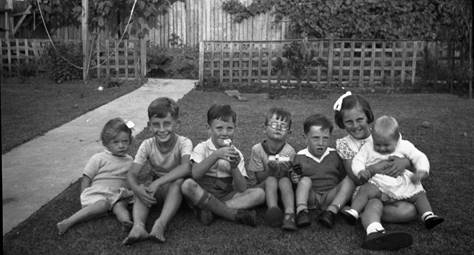
The Lane Cove gang taken in December 1949. From left to right: John and Christine Allison, Michael Wilson, Peter Allison, me, and Marie Wilson holding Narelle Wilson. The Lane Cove gang will feature in the third and fourth books of my family history series.
His schooling was in Catholic schools run by religious orders. He owes an enormous debt to those religious nuns, brothers and priests who provided him with an excellent education. The majority of those religious were conscientious and dedicated people of outstanding character. He can remember only one occasion in all those years when the conduct of a religious brother was reprehensible, an account of which he will give in the fourth book of his social history series.
Despite a fun-filled, trouble-free family life, the example of caring mother and father, and his good education, he arrived at Sydney University in 1964 with a teaching scholarship and, alas, a regrettable immaturity. To demonstrate the pitiful orientation of his mind, he went about making a complete mess of his studies and just about every other responsibility an eighteen-year-old carries. But it was not left-wing politics that had him in its thrall, causing him to erupt obnoxiously—as one may be inclined to think, considering the times. Just ordinary teenage immaturity.
As green and callow as he was, though, he was not beyond being impressed by the nastiness, hypocrisy and ideological bigotry of the sixties radicals—and he saw them close-up. It was the first indication he was sadly out of step with his contemporaries, reflections of which would make their mark in his first two novels, almost forty years later, and eventually laid out in extensive detail in his book Tony Abbott and the Times of Revolution.
Nor was he beyond recognising the futility of pursuing his studies while he could not organise himself. He discontinued university studies without having a clear idea of what he was doing or where he was going. In this spirit, he wandered until December 1968, when he met a Dutch girl who had recently arrived in Australia on a working holiday. His mother said Ineke was the answer to her prayers.
A year later, they married, and another year later, they set off for Holland without any plans of how long they would stay there. The immersion in a different culture and a different language was exhilarating. (See My Holland Experience page.) Again, reflections on what he experienced and learned in Holland would appear in the same two novels. Despite the intellectual and cultural invigoration of living in another country, he decided that with two children now on the scene, they would be better off in Australia. This was another life-changing decision.
On their return to Australia, he could not land a job in the airline business where he had been working. It was January 1974, and there was a worldwide fuel crisis, the result of the Arab states withholding their oil. He was forced to look around for temporary work and, in a short time, found himself on the short list for three sales positions with educational publishers. He took the first position offered and, after a mere six weeks, found that Providence had led him into work that his education, abilities, and interests made an exact fit.
A couple of years later (1976), he returned to part-time university study. His major studies were first Dutch Language and Literature, and then philosophy. He ended up studying through to an MA in philosophy. The title of his master’s thesis was Natural Law Conservatism: The Epistemological Foundations of the Political Philosophy of Edmund Burke. He is slowly revising and updating this work under the title of Edmund Burke: Knowing and Reasoning in Politics.
About halfway through his secondary school days, he began scribbling—both fiction and non-fiction. He remembers commenting to friends in 1964 that he wanted to be a novelist but would need broad life experience before he could begin writing. Around forty years of age, he said, would be a good time to retreat to the garret, trim the oil lamp and sharpen the quill (excuse the clichés)—a feeble excuse to prevaricate, which he was good at in those years. As it turned out, he eventually summoned up the self-discipline and sat down to write in 1982 when he was thirty-six. The feelings had been building for a long time, and his head was full of thoughts that had to be got out. He scribbled around 350 foolscap pages before he decided he had written a lot of rubbish. Something was missing. He needed to clarify his thoughts in a moral and political sense. It was then that he switched from literary studies to philosophy. Another crucial decision.
He was entranced by the texts of the great philosophers: Descartes, Hume, Locke, Hobbes, Kant, and others. Nevertheless, there was something unsatisfying about it all. He found himself in an intellectual dead-end of scepticism and moral relativism, both in contradiction of his faith—yes, miraculously, he retained his faith, which for him makes sense of the world—and of the everyday reasoning of ordinary people. The rabid lefties around him raged against the oppression of bourgeois capitalist society. They could not think their rage meaningless. The philosophy lecturer who hammered the scepticism angle appeared oblivious to the fact that he arrived promptly at the right time in the correct lecture room after never doubting the multiple true decisions he made from leaving home until he arrived at his intended destination.
Professor John McCloskey of La Trobe University’s philosophy department took pity on his struggle against the intellectual tide and suggested some fruitful avenues of reading. Among others, he was introduced to the writings of one of the 20th century’s great political philosophers, Michael Oakeshott. His essay Rationalism in Politics gave him the clue. Modern philosophy had it all wrong, he decided, the method of rationalism being the culprit. For him, there was a short step from Oakeshott’s critique of rationalism to Edmund Burke, father of modern conservative thought.
Burke’s attack on the French Revolution, which amounted to an attack on the mode of reasoning of the French radicals, was convincing. And he aimed in his thesis to show just that. On the way, he was introduced to the great tradition of classical realism and was led back through Hooker, the scholastics (the greatest of whom was Aquinas), to Augustine and to the source, Aristotle. Intellectually, he was home.
With his thoughts clarified, particularly regarding the different modes of knowledge a person relies on in different fields, and the harmony between faith and reason strengthened, he returned to his writing. It was, however, to non-fiction that he turned. He wrote two books on the media (The Media of the Republic andThe Telecard Affair: A Diary of a Media Lynching). These two books applied the themes of his thesis on Burke. They received good reviews, particularly the first. With these two non-fiction books completed, it was time to get serious and return to his first love: the novel.
He threw out the 350 pages of rubbish and began anew. The story that had been floating around in his head for twenty years quickly became an idea for a series of novels. The first two books, The Castle of Heavenly Bliss (now Book 7) and In This Vale of Tears (Book 2) received favourable reviews and an enthusiastic response from most readers (see the ‘books’ page for comments and reviews). His concentration is now on his Sixties Series, which will include eight standalone but connected titles, six of which have been published, with the seventh, Dreams to Nightmare, due early 2027.
A major theme in each title in the Sixties Series is the transition from the innocence of traditional life in the 1950s to the mayhem of the 1960s cultural revolution, and how each character deals with the moral and political upheaval.