
A History of a Catholic Family
Part 3 1946-1953
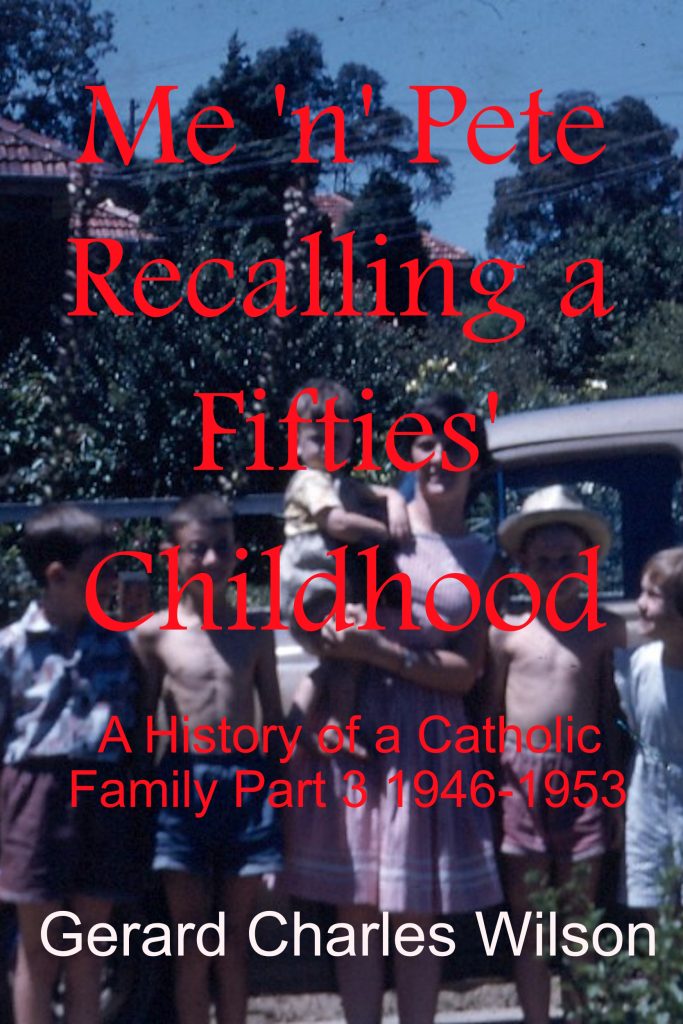
A social history of Australia, not of the famous and heroic, but of the small people, the anonymous people who were the heartbeat of a growing nation
What did kids do in the 1950s when there were no smartphones, tablets, and computers? They roamed the neighbourhood on scooters and bikes. They went on bush hikes. They went to Saturday matinees where the theatres were packed to the rafters, and kids yelled at hero-action and booed kissing. Most of their pleasures were self-made. Besides roaming the streets free of risk, kids enjoyed trips to the beach and zoo. There was hardly a greater thrill than a double-decker bus trip to town to see the Christmas displays. Christmas in the city was a wonderland of toys and amusements.
The 1950s now seem idyllic to many people in their seventies and eighties. It was so different from the first decades of the 21st century that those years are now like another world, an impossible world of social and moral values. In today’s atmosphere, it is hard to imagine it possessed any legitimate social and moral coherence.
The author looks back on those years he lived through, telling the story as much about the world he grew up in as about himself. He starts with his birth in July 1946 and ends with the end of his second year at primary school, 1953, when he turned six and learnt to read. It was also the year that Princess Elizabeth was crowned Queen of England, a supernova event for Australia.
The author’s story involves his lifelong friend, Pete, a rubella baby, a condition that tragically took his already poor sight in his teenage years. Pete’s story, told as an adult without sight, is fascinating.
1946 was the year after the Second World War ended. Despite an optimistic outlook, Australia was full of talk of the war—of the threat of war, of the suffering in the POW camps, and of lost loved ones. The author’s upbeat father, just discharged from the navy with the rank of Chief Petty Officer, put it all behind him and began building the family’s first house in Lane Cove, a suburb on the north side of Sydney Harbour, and the scene of his childhood. Their new three-bedroom, double-brick home was like a palace.
For a boy who, according to his mother, had ants in his pants, the author remembers many of the social and political events that provoked his father into long, loud comments.
The local convent under the regime of the Mercy Sisters is an unmissable part of his story. He recalls with affection the sisters’ teaching methods and their strict regimentation of their pupils. He thinks some of their disciplinary methods are rather amusing to look back on, rather than being condemned. He regards the class of 1953 as the end of a phase in his development when he learnt to read. The following year, 1954, was rich in social and political events and marks the start of the fourth book (1954-1958) in the family history series, Communists, Billy Carts and Two-Wheelers.
Buy from Amazon HERE …
Other outlets HERE …
Other titles in the Social History Series:
Prison Hulk to Redemption Part One 1788-1900
War Depression War Part 2 1901-1945
Communists, Billy Carts and Two-Wheelers Part 4 1954-1958 (no pub. date)