
Knowing and Reasoning in the Writings and Speeches of Edmund Burke
Due for release 2027
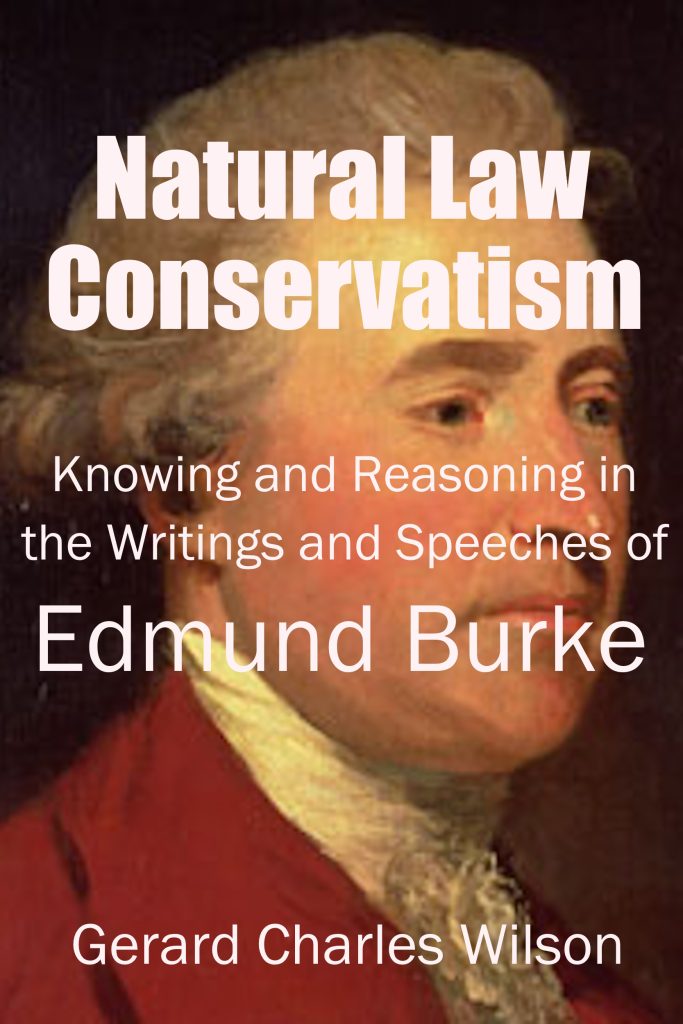
In this work, I propose to set out the fundamentals of natural law conservatism by providing a detailed exposition of Edmund Burke’s political philosophy. Edmund Burke was an eighteenth-century British politician of Irish birth who was closely involved in the major political issues of his time. I aim to show, first, that to justify his stands, Burke fell back on a coherent set of moral and political principles based on a particular understanding of the natural law and, second, that he set these principles within an unifying epistemological framework. He was often explicit about what we can know and how we can know it, but the framework was implicit in all that he said about the formulation of policy and political action.
The project will be presented in four parts. Part One will serve as an introduction to the controversy about the very claim that a Burkean philosophy exists. In addition to surveying various views on Burke’s alleged political philosophy, I will briefly look at recent scholarship on eighteenth-century natural law and the methodology proposed by recent work on the historiography of eighteenth-century political discourse. Part Two will examine the arguments running through a number of pamphlets and speeches that address major issues in Burke’s political career. This examination is designed to isolate key features of Burke’s political and moral vision and its connection with a natural law view. Part Three will use Burke’s material on the French Revolution and Jacobinism to bind together the account of his fundamental moral and political principles and to show how his concept of obligation arises from this. In Part Four, I will attempt to show how Burke’s moral vision is unified by an implied epistemological scheme that delineates the possibility, the acquisition, the ratification, the maintenance, the revision and correction of moral knowledge. I will propose that Burke’s epistemology can be seen as forming a ‘contextual’ basis of knowing and reasoning. An important distinction will be made between a ‘contextual’ epistemology and an atomised epistemology.
Return to My Non-fiction